


















Throughout the history of music among mankind there have always been innovators: people or groups that produce something that others could not even think of. A very prominent example of this is the artist TOOL. TOOL is a progressive rock/metal band formed in Los Angeles in 1990. While their first record, Undertow, could be seen as not anything completely out of the ordinary, the experimentation and development of their unique style and sound only grew.
By their second album, Ænima, TOOL had thoroughly begun their reign of defying genres and leaving listeners wondering what the hell they just listened to and why they liked it. After five years from Ænima, TOOL’s third studio album was released on May 15th, 2001. The title is Lateralus, which is allegedly a combination of the leg muscle, Vastus Lateralis, and the term “Lateral thinking.” Musically, the album is interesting enough, containing a vast array of time signatures and key changes that sound like a horror story to our Music Theory students. This album debuted at number 1 on the Billboard Top 200. The song, Schism, even won a Grammy for the best metal performance.
The way that the songs feel almost entrapping is a key component of what makes this album so special. Songs typically have a longer run length, which can scare away potential listeners. But these aren’t 6-8 minute songs of the listener hearing the first minute and a half 5 times, these are 6-8 minute songs that can’t be turned off because they’re unpredictable. In my experience of listening to this album front to back the 79 minute run time didn’t feel like a marathon because nothing is a loop, there are no parts that lazily repeat and rerun to make up such a long record.
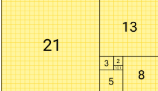
While the music itself is compelling and impressive by itself, the composition creativity just adds even more of a distinct touch to the album. There are so many components and details that really allow a listener to appreciate Lateralus even more. For example, the song Faaip de Oia, which is one of many interludes, is translated to “The Voice of God” and is derived from the Enochian language: a language used to practice Renaissance magic. The most interesting detail about this album is the title track. Lateralus is based on the Fibonacci sequence which is a pattern in mathematics where each component is the sum of the two numbers that preceded it. Additionally, the song also references the Fibonacci spiral, which is the shape created by arranging the sequence in boxes, as seen in the image to the left. After ordering the numbers, draw a spiral that hits two corners of each box. By continuing the sequence indefinitely, this will create a spiral that is infinite. To add to all of this, the main theme in the song is written in the time signatures 9/8, 8/8 and 7/8. The integer made by combining the first numbers in the signature is 987, which is the 16th number in the Fibonacci sequence.
There are so many smaller finite details that make this album so interesting to research and listen to. I strongly recommend listening to and further researching Lateralus because this album could not broaden your musical horizon. This album will go down as one of the most unique and impressive works of music I’ll ever listen to.
Genre: Progressive Metal, Experimental Rock.
Length: 1 Hour and 19 Minutes.
Fans also like: Gojira, Alice in Chains, Soundgarden, Pantera, Rage Against the Machine.
Favorite Songs: Parabola, Ticks and Leeches, Disposition
Least Favorite Song (Excluding Interludes): The Patient
Ranking: 9.1/10